Sales acceleration with Product Catalog and Pricing at your finger tips


Sales are mainly customer-initiated through self-service or through your internal Sales team. Either way, both of these channels rely on having accurate pricing and service availability.
The Microsoft Cloud Solutions Provider (CSP) Program has a product catalog of close to a thousand subscription services. There are changes to the product catalog on a monthly basis. Products are retired, there are changes in availability, pricing changes, and currency fluctuations.
Learn how Work 365 can simplify your product catalog management.
Having current pricing in your product catalog for your sales team can boost sales, save time, and increase customer satisfaction. A customer using Microsoft cloud services will tend to consume services in an additive way. They may start out with a basic service, add security, voice, and other services as they become more aware of their needs, transition existing services, or just adopt new products as they become available. The Microsoft Partner Center (PC) makes it quite easy to provision new services. However, the provisioning process when it is disconnected from the sales and billing process creates a significant operational challenge for any Managed Service Providers (MSPs). Learn how you can get a grip on Office 365, Microsoft 365, Azure Billing, and Provisioning challenges.
Product catalog management helps you organize and consolidate product data into a single, digital point of reference. In an optimal selling environment, the catalog maintains and stores product information for your e-commerce website, a self-service portal, and or your internal teams.
It’s the strategic process of managing and maintaining your product catalog to ensure the quality of your product data across all channels (sales and services). It includes how you organize, standardize, and publish your product data to each channel.
Product catalog management ensures the quality of product data, by allowing an admin to update the product information in a catalog, so that customers can make informed buying decisions. The seller can help buyers make those decisions by providing important details for their decisions. These solutions are typically bundled with additional e-commerce marketing software and other support tools.
If you think about the concept of product catalog management, it seems very simple, right? You just must maintain a single catalog of all the products you sell online.
01- Updates
Product Updates in the subscription business, products are being constantly added, removed and their prices can change at any time. How would you keep up with all these changes? Is your sales team selling the product with the right pricing and markup?
02-Hierarchy
Product Relationships different types of products can make SKU management more complex and often have parent-child relationships that can be hard to manage. How do you ensure that SKUs relate to their parent item, but also are represented as individuals?
03-3rd Party
Third-Party Product Data If you receive product data from third parties like Microsoft Partner Center or Distributors, this data can come in all sorts of formats. You must make sure all attributes are organized as necessary for your optimal operation.
04-Multiple Channels
Selling on Multiple Channels another challenge of product data is managing it across multiple sales channels. Each of these channels requires a specific format of your product data for listing purposes.
05-Customer Specific
Customer-specific Pricing Plans the same product can vary in price according to your buyer. This is common practice in our industry. Individual customers or groups can have their own specific pricing structure. It’s important to maintain this information because you’ll want to ensure that the right prices show up for the right customers. Offering the best buying experience possible.
Product data can become messy, fast. It can be tedious and time-consuming for businesses to normalize product data from other sources to meet their internal requirements. In our industry, many businesses often have large teams who spend weeks compiling, updating, and publishing product data. Not only is it hard on your operations, but it can also result in the wrong and inconsistent data on your website for customers, sales, and operations teams. Incorrect product information can lead to bad experiences, incorrect billing, and revenue leakage.
With all these issues in mind, our team developed a simple, straightforward forward but robust product catalog management for our Work 365 Billing and subscription application.
Watch the following video to understand and see the Product Catalog Management in action:
 https://www.work365apps.com/wp-content/uploads/2026/09/Multi-Currency-CSP-Billing.png 320 485 Amar Patil https://work365apps.com/wp-content/uploads/2025/05/logo-small-size.png Amar Patil2026-09-23 10:00:362026-09-29 10:04:56Multi-Currency CSP Billing: How Microsoft Partners Manage FX, Pricing, Reconciliation and Margin
 https://www.work365apps.com/wp-content/uploads/2026/09/CSP-FINANCE-OPERATIONS.png 320 485 Amar Patil https://work365apps.com/wp-content/uploads/2025/05/logo-small-size.png Amar Patil2026-09-15 10:02:292026-09-29 10:05:28Annual Upfront vs Annual Monthly: Where CSP Billing Risk Sits
 https://www.work365apps.com/wp-content/uploads/2026/09/CSP-PRICING-UPDATE.png 320 485 Amar Patil https://work365apps.com/wp-content/uploads/2025/05/logo-small-size.png Amar Patil2026-09-10 09:58:562026-09-29 10:04:40October 2026 CSP Software Price Change: What Microsoft Partners Need to Do
 https://www.work365apps.com/wp-content/uploads/2026/09/Most-CSP-margin-leakage-is-structural.png 320 485 Amar Patil https://work365apps.com/wp-content/uploads/2025/05/logo-small-size.png Amar Patil2026-08-25 10:01:332026-09-29 10:05:11Most CSP margin leakage is structural, not human error
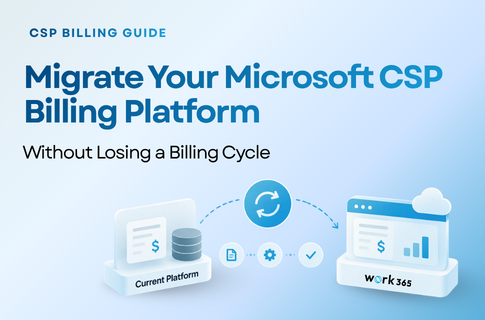 https://www.work365apps.com/wp-content/uploads/2026/09/Migrate-Your-Microsoft-CSP-Billing-Platform.png 320 485 Amar Patil https://work365apps.com/wp-content/uploads/2025/05/logo-small-size.png Amar Patil2026-08-14 10:03:302026-09-29 10:05:44How to Migrate Your Microsoft CSP Billing Platform Without Losing a Billing Cycle
 https://www.work365apps.com/wp-content/uploads/2026/09/2.png 320 485 Amar Patil https://work365apps.com/wp-content/uploads/2025/05/logo-small-size.png Amar Patil2026-08-05 09:57:562026-09-29 10:04:21Renewal Discipline: How CSPs Protect Revenue in 2026
Products

Solutions
Resources
Company
Reach Us
11710 Plaza America Dr. Suite 2000, Reston, VA 20190, USA
sales@work365apps.com
+1-571-429-5171


 Work 365 Newsletter June 2020